15 years in HR. One pattern across every industry. Most recruitment agencies run two teams — one that sells, one that delivers. Here's what it's costing you.
The Two-Team Problem: Why Most Recruitment Agencies Are Designed to Disappoint You
After 15 years in HR across every industry in India, I've watched this pattern repeat without exception. Here's what's actually happening — and what it's costing you.
Last year, I gave a recruitment agency a chance.
I already knew how it would end. But after 15 years in HR — across startups, mid-size companies, and listed enterprises — I wanted to document it properly.
Their pitch was polished. Top brands. Proprietary AI. Domain experts. I've heard this exact script more times than I can count.
I said fine. Gave them a role. Then I sat back and watched.
Week one: silence. Week two: three CVs — wrong designation, wrong salary band, one candidate hadn't applied. Week three: they called my own candidate. The candidate didn't recognise the agency's name.
This is not a one-agency story. I've seen this pattern in every industry in India. FMCG, tech, retail, logistics, fintech, manufacturing — startups to listed enterprises. Without exception.
The reason is structural. And once you understand it, you'll never look at a recruitment agency pitch the same way again.
The Two-Team Structure
Every recruitment agency — small or large — runs on two fundamentally separate teams.
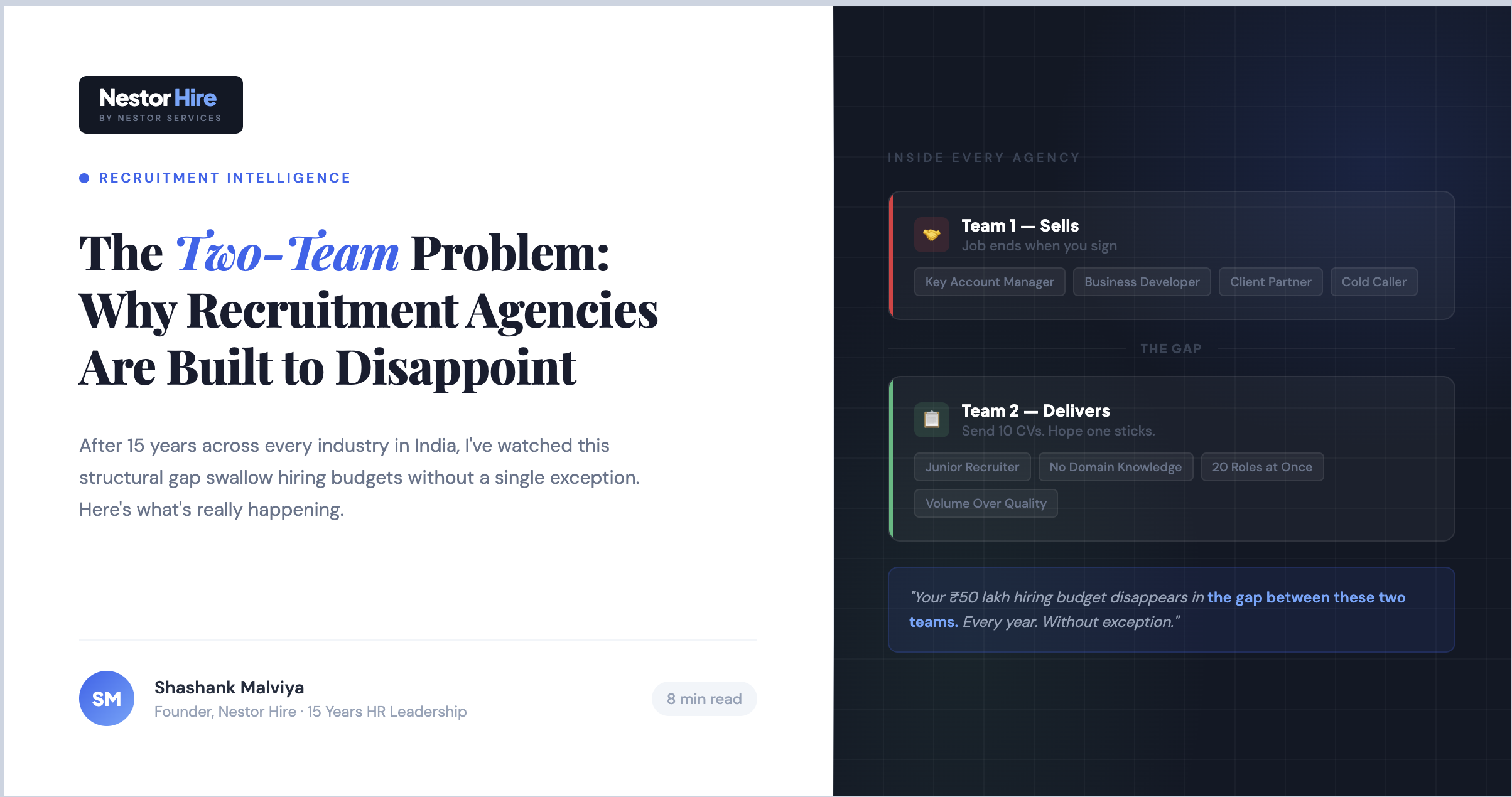
Team 1: The Sales Team
These are the people who called you. They go by many names — Key Account Managers, Business Developers, Client Partners, Client Success Associates. The titles sound strategic. The job is simpler: get the contract signed.
They are measured on revenue closed. Number of clients acquired. Logos added to the pitch deck. Their job ends the moment you sign. What happens next is not their responsibility.
This team is very good at what they do. They know your name, your designation, your company. They have your number from LinkedIn or a job portal. They will mention three brands you recognise in the first 90 seconds of the call.
What they typically don't know: your industry, your role requirements, your team culture, or what a good candidate actually looks like for your specific context.
Team 2: The Delivery Team
This is where your recruitment actually happens — or doesn't. These are the junior recruiters, the sourcers, the coordinators. Often fresh out of college. Often with no domain knowledge in your industry. Often managing 15 to 20 open roles simultaneously across completely unrelated sectors.
Their job is volume. Send CVs. Follow up. Fill slots. The math is simple: if they send 10 profiles, statistically one will move forward. Invoice raised. Case closed. Move to the next role.
There is no malice here. These are people doing a job they were given without adequate training, tools, or industry knowledge. The problem is systemic — not personal.
The founder or agency head? Already in the next business development meeting. Your open role is a line item on a spreadsheet.
What This Is Actually Costing You
Let's talk numbers — because this is where the conversation gets uncomfortable.
If your company hires 50 people a year at an average CTC of ₹12 LPA, a typical recruitment agency charges 8 to 10 percent per hire. That's ₹1 lakh per hire. ₹50 lakhs a year.
For what you actually receive:
- CVs that don't match your requirements
- Candidates who ghost after the first interview
- A delivery team that doesn't know your industry
- No accountability after the invoice is raised
- The same candidates being submitted to your competitors simultaneously
I receive more than two agency pitches every week — even now, when hiring is slow and market conditions are cautious. The pitch never changes. Same logos dropped. Same AI claims. Same urgency language. Different letterhead.
Why "We Have AI Now" Doesn't Change Anything
In the last 18 months, every agency pitch has added one line: "We've integrated AI into our process."
What does this mean in practice? Usually: a keyword matching tool that surfaces CVs faster. The same CVs. Delivered faster. By the same junior recruiter who still doesn't know your industry.
AI without judgment is just faster noise.
Real recruitment — the kind that results in hires who stay, perform, and contribute — requires deep understanding of the role, the team, the culture, and the candidate as a human being. No tool replaces that. Not yet.
What Good Recruitment Partnership Looks Like
In 15 years of operating as a consultant, I consistently applied one principle: I work as if I am an employee of my client.
Their values are my values. Their urgency is my urgency. Their culture is my filter. I do not send a candidate I would not personally vouch for. There is no perfect candidate — but there is always a closest fit, and finding that fit requires homework, not cold outreach.
Good recruitment partnership looks like this:
- Understanding the role deeply before sourcing begins. Not just the job description — the team dynamic, the manager's style, the growth trajectory of the position.
- Presenting fewer, better candidates. Not volume. A shortlist of five candidates who genuinely fit is worth more than fifty CVs that don't.
- Staying accountable after the hire. If a candidate leaves in three months, that is a recruitment failure. Good partners take responsibility for that.
- Transparent, flat-fee pricing. Not per-hire commission structures that create incentives to fill roles fast rather than fill them right.
The Nestor Hire Approach
This is exactly why I built Nestor Hire as a managed recruitment service — not a traditional agency.
No business development team chasing the next logo. No junior recruiters managing 20 roles simultaneously. No per-hire commission structure that rewards speed over quality.
A flat managed service fee. Full accountability. One team that understands your business end to end.
For what a traditional agency charges in a year, you can run a fully managed recruitment operation at less than half the cost — with someone who operates like a member of your own HR team.
Conclusion
The recruitment agency industry in India is large, largely unregulated, and built on a structural gap between what is sold and what is delivered.
This is not changing soon. The incentives are misaligned at a fundamental level.
What you can do is understand the structure, ask the right questions before you sign, and demand accountability that goes beyond the CV delivery.
And if you're tired of paying ₹50 lakhs a year for someone who didn't read your profile before calling — you know where to find us.
Author Bio
Shashank Malviya is the Founder of Nestor Hire, an AI-powered managed recruitment service. With 15 years of HR leadership experience across FMCG, tech, retail, and startups, he has worked with companies including Country Delight, Housing.com, PropEquity, and WNS. Connect on LinkedIn.
Book a Discovery Call
Book a Discovery Call →Nestor Hire
Explore live roles and candidate experience on the higher-traffic Nestor Hire platform.
Explore roles →Nestor Services
Visit the homepage to understand how Nestor Hire and Nestor Core connect.
About Nestor Services →